|
Tuesday, December 11, 2012
3.14 and so on
Title: Life of Pi
Author: Yann Martel
Bookmark: the official recycled bookmark of the Union Pacific Railroad
When I started reading this (yes, because of the movie), I remembered that it had been reviewed here previously, but I had forgotten every word of the review. I just re-read it, and completely agree. The novel starts by tooting its own horn, with the purported author's tale of how he discovered the story (it's told as though he found Pi as an adult living in Canada and got the story from him) upon meeting a man in a tea shop in India who told him he had a story that would "make you believe in God." Old man tells writer to go find Pi in Canada, author begins friendship with adult Pi, Pi begins telling his story. So begins Part Two of the three-part book.
I love a good survival story, and if it's true, even better. This book has neither quality. You'd think that putting a boy in a small boat with a large tiger in the middle of the Pacific Ocean would lead to a great survival story, but it doesn't. I was actually disappointed when he discovered the overwhelming wealth of survival equipment in the lifeboat's storage locker. Like Kate, I was frustrated that after going to such lengths to make everything about the journey totally believable, there's a sudden sci-fi/fantasy twist in the eleventh hour which hangs around just long enough to make you think, "ok, so maybe the first 321 pages were just a set-up, and this is the real story that gets everybody so worked up," and is then passed over and forgotten. I was already annoyed that he had bumped into another lonely shipwreck survivor in the middle of the Pacific--that was too much stretch for me--and suddenly he finds a mysterious floating island? It felt like Martel's publisher told him "we're about thirty-six pages shy. Can you pad this with something?" "Well, I have this really fun idea for a sci-fi short story; it's a little like Perelandra, but the island is carnivorous, and chock-full of fish-chomping meerkats." "Whatever. Stick it in there."
Yeah, sure, it's a nice, diverting read. It is not as life-changing as everyone seems to think. Honestly, it's a little annoying. There's a couple scenes at the end when two Japanese guys are interviewing Pi in a Mexican hospital, and occasionally have side conversations between themselves in Japanese (translated in the book) so he can't understand. It's the best part of the whole book. It shows great humor, and the dialog is entertaining, with funny bits both in the words shared and in the actions described (Pi, after being stuck on a boat with a tiger for almost a year, composing soliloquies about food and hunger, keeps asking them for cookies. They comply, knowing that he has piles of cookies hidden under his bedsheet. When they get tired and frustrated about his story, he offers them cookies which they graciously accept. There's also a funny exchange about how arduous their drive from California was, and he consoles them about their difficult journey.). But it feels a little like a shaggy dog joke, since it comes after 365 pages of set-up.
I've lost interest in the movie.Labels: adventure, Canada, cannibalism, finding oneself, fish, monster, talking animals, undeserving classics, young protagonists
posted by reyn at
11:23 AM
0
comments

Thursday, May 12, 2011
bum-ba-BUMBUM
Title: The Lost Journal of Indiana Jones
Author: Henry Jones, Jr. (OBVIOUSLY)
Bookmark: built-in
Yeah, I know he's not real, and I know someone else filled the book with made-up stuff as some distantly connected movie tie-in for The Crystal Skull, but I don't care. It didn't even matter that I never got to see the Young Indy Chronicles TV show. The book has bits and pieces of the entire Indy legend, referring to episodes of the show and key points of all three original movies (before TCS, but with allusions to its beginning), depicted in "handwriting" and drawings that improve with Indy's age and experience and illustrations made to look like taped-in photos, maps, cocktail napkins, and plane tickets. I can admit that it's a gimmick, but it's a very well-done gimmick, filled with sly humor (there is a pro/con list for the shrill femme of Temple of Doom which includes pro: not afraid of snakes and con: loud) and clever references.Labels: adventure, epistolary novels, fake autobiography, hunky armed forces or government operatives, monkeys, secrets
posted by reyn at
10:58 AM
0
comments
Thursday, April 21, 2011
Can't touch this
Title: Touching the Void
Author: Joe Simpson
Joe Simpson and Simon Yates, both experienced climbers and mountaineers, set out to complete a first ascent of the west face of Siula Grande (an icy, storm-thrashed mountain in the Peruvian Andes). With a few difficulties and minor close calls, which are to be expected on a major ascent like that, they made the summit. Then everything went wrong.
The book is subtitled "The True Story of One Man's Miraculous Survival," before I was even a third of the way through, I was impressed that either man had survived. Both of them had terrifying falls which could have ended the trip and their lives. The biggest difference is that when Yates fell, he was caught by the rope, dangled free of the snow cliff, and managed to climb back up to Simpson. When Simpson fell, he landed on ice and shattered his knee.
I'm not providing any spoilers by telling you this; the whole story is well known. Even the back cover of the book tells you that Simpson broke his leg (bad news anywhere, but especially bad when you manage to break it in as spectacular a fashion as Simpson did, on top of a mountain, days from any medical support) and Yates had to help him down. It tells you that during the process of lowering his friend, something else went wrong, and Yates was forced to cut the rope, letting Simpson drop. Both men expected themselves--and each other--to die, but both survived. You don't read this book to find out what happened; you read it to find out how it happened. How both men struggled with the circumstances, their own decisions, and the harsh environment surrounding them. You read it to find out how they pushed themselves to survive, and find yourself wondering whether you could have done the same.
This book is subtitledLabels: adventure, friendship, memoir
posted by reyn at
9:37 AM
1
comments
Monday, March 07, 2011
How deep DOES the rabbit hole go?
Title: Blind Descent
Author: James M. Tabor
Everest is old hat. It's a tourist site. All you need is a big pile of money, and two months off work, and you can hire someone to guide your sorry keister to the summit, assuming you are also physically capable (but pretty much everyone uses bottled oxygen). Some explorers decided to go the opposite direction; they sought the deepest cave on earth.
Problem is, you can look at mountains and tell they're really big, and even get a good idea of which one is biggest (although some clever trigonometry settled it in the case of Everest), but you can't tell how deep a cave is--or even which caves might be promising--without trying to find the bottom and measuring. And finding the bottom of caves that big is a royal bitch. People die.
In Mexico, Bill Stone believes the Cheve cave system will win the title of World's Deepest Cave; in the Republic of Georgia, Ukrainian Alexander Klimchouk believes Krubera will prove deeper. Both caves offer unique challenges; both men have very different styles of leadership and caving. The book covers both, and I'm a little torn on how I feel about it. The story is fascinating, but the writing was a little disappointing. Tabor spends a lot of time stressing how dangerous caving can be, but it feels a little like he's trying to crank up tension to drive the book, and the effort seems forced. If you're submerged in 40 degree water, belly-crawling in the dark, nearly a mile underground, you don't need anyone to tell you it's dangerous. At the same time, very little explanation is given to topics that need it--and that's coming from someone who's spent a lot of time dangling from climbing ropes. If I can't figure out what's going on, people who have never climbed or caved will be completely lost. There's a lot of good information, but it feels poorly organized.Labels: adventure, non-fiction, o pioneers
posted by reyn at
1:59 PM
0
comments
Friday, January 28, 2011
In space, only your crewmates can hear you fart.
Title: Packing for Mars - The Curious Science of Life in the Void (find in a library)
Author: Mary Roach
Bookmark: a stick with a lizard in it.
Somehow, I had never before heard of Mary Roach. I'm glad that oversight has finally been corrected. Roach is apparently well-known for writing eye-watering funny books about science, presented with stunning frankness and candor and (if this book is any indication) filled with first-hand research. Not that she actually went to Mars to prepare for the book, but she did ride the Vomit Comet, visit space agencies in three different countries, and travel to NASA's research station on Devon Island in Canada, which is so lifeless and cold that it's the next best thing to an actual moon landing.
Packing For Mars isn't about space travel--not really. It's about how humans can travel in space (and a couple dogs, and a few primates). Hardly any time is spent on rockets, booster engines, and possible future drive systems. This book is all about what space does to us. How our bodies are affected by weeks (and months) without gravity, bathing, fresh food, privacy, and free time (astronauts' schedules are rigorously structured), and how each of those difficulties have led to astonishing breakthroughs in almost every realm of science. To get at those answers, Roach has gone to some unusual lengths to find the truth about space travel, and anything fascinating or hilarious that she discovered but didn't fit in the main text is likely to have found a home in her copious footnotes. One of my favorite examples comes from the chapter on sex in space, which found Roach talking to marine biologists to find out how dolphins mate, watching porn to find an elusive scene of sex unencumbered by gravity, and poring through an impressive amount of archive material to discover the truth about an alleged masturbating astrochimp:
*Further evidence of the difficulties of reduced-gravity sex comes from the sea otter. To help hold the female in place, the male will typically pull the female's head back and grab onto her nose with his teeth. "Our vets have had to do rhinoplasties on some of the females," says Michelle Staedler, sea otter research coordinator at the Monterrey Bay Aquarium. (Sex can also be traumatic for the male otter, who endures aerial pecking attacks by seagulls mistaking his erect penis for a novel ocean delicacy.) Roach focuses not on technology itself, but on how humans must interact with it to survive an environment we are not designed to survive. An entire chapter is devoted to the history and various advancements that allow astronauts to go to the bathroom without gravity (it's more difficult than you might think--without gravity pulling things down, our internal sensors can't tell when we're full. Astronauts have to set a schedule and stick to it, because they can't feel it when they have to go. Then there's the problem of getting detachment from both solid and liquids, both of which want to cling, and the danger of waste drifting out of a system that can't use gravity to contain it.). And that's good, because there are those that will ceaselessly point out that we can gather information from space more easily and with far less expense by sending robot probes instead of eating, breathing, sleeping, pooping, sweating, farting people who are fragile, susceptible to radiation and lack of gravity, water, and oxygen. People argue, stink, have individual wants and needs, and don't like eating the same colorless paste for days on end. And, as Roach points out in the final chapter, that is part of why people should go to space. Because we're people. We smell funny, we fart, we want variety in our food, we enjoy sex, we need to sleep almost a third of the time we're alive, but we dream, we innovate, we aspire, we wonder, and while we can represent some of the worst evils imaginable, we can also exhibit the greatest virtues imaginable. I've always been fascinated by space. I've always wanted to be an astronaut, and I've never needed anyone to convince me that we need to get up there. I cried when Challenger exploded, and kept a picture of Christa McAuliffe on my wall for years afterward. (Incidentally, the challenger disaster was 25 years ago today) Still, this book filled me with wide-eyed wonder, hope, and amazement just as often as it made me laugh hard enough to worry that the neighbors might be concerned.
In the spirit of Mary Roach's own footnotes, how great is it that a writer known for combining humor and science is named "Roach"?Labels: adventure, history, non-fiction, science, space
posted by reyn at
1:14 PM
1
comments
Friday, September 12, 2008
James Bond, the fourth wall, and a boxcar full of drugs
Title: Lost in a Good Book
Author: Jasper Fforde
Bookmark: paper wrapper for a reflector from a messenger bag
I've recently been digging my way through a collection of pulp ffiction large enough to herniate a yak, and--much as I've enjoyed it--I needed a break. I got a craving ffor something clever, inventive, endlessly wacky, and a lot more ffun than all the noir I had recently absorbed.
The very ffirst thing that came to mind was Thursday Next.
Years ago I read The Eyre Affair, a brilliantly original and relentlessly hysterical story of good vs. evil and revisionist ffiction. Elizabeth couldn't stand it, and this only makes me defend it all the more staunchly. Her biggest problem was that the characters didn't act as she ffelt they should.
Ffear not, readers--Fforde has explained that.
I had fforgotten some of the major points of Eyre Affair by the time I started this sequel, but Fforde catches you up quickly, and what you don't remember doesn't matter much--this story easily holds its own, and delves even deeper into Next's bizarre world. In her version of England, the Crimean War has only recently ended, Churchill was erased from history, dodos, mammoths, and Neanderthals roam ffree as the results of cloning experiments, and books are more popular than movies are to us.
Really, really popular.
People have their names changed to that of ffavorite authors or characters, some names becoming so popular that they had to start appending subscript numbers to distinguish all the Anne Hathaways and Charlotte Brontes ffrom each other. The discovery of a lost script by Shakespeare has the potential to change the result of an upcoming election. A sale at a bookstore involves people getting punched, kicked, trampled, and shot.
Next works for a police organization known as Special Operations, divided by numbered divisions into groups policing everything from agriculture, literature (SO-27, Next's department), vampires, and the timeline (ChronoGuard; SO-12, Next's ffather's department until he went rogue). Her latest case opens with the discovery of a script for Shakespeare's Cardenio, moves on through multiple attempts on her life orchestrated through outstanding coincidence, her ffather's discovery that the world will end in mid-December, and the Goliath Corporation's highly intrusive meddling in Thursday's personal life.
It's ffilled with so many literary references that I wanted to read it with Wikipedia close at hand so I could determine how many were "real" and how many ffabricated ffor Fforde's universe, puns ranging from brilliant (Next meets a pair of SO-5 operatives named Lamme and Slorter, who replace Kannon and Fodder--that pair died after just one chapter of work tracking down one of the most dangerous criminals nobody ever remembered) to clumsy, but worth it (a main antagonist is Mr. Schitt-Hawse. Much later, we ffind out his ffirst name is Brick), and the sort of bizarre ideas that could only come ffrom a lifetime of nurturing an overactive imagination, or a lifetime of heavy drug use. Fforde writes books that could only be created by someone who put down the classics long enough to read stacks of sci-fi and ffantasy, or watch marathon sessions of Monty Python.
Oh, and to any detractors who were disappointed in how Fforde portrayed their beloved Bronte characters, the discrepancy is explained, though not directly. As it turns out, Fforde's portrayal is the true one; the characters you know from reading the original Bronte were just roles those characters played. The Dashwoods of Sense and Sensability are very distressed to learn of the reading world's mean opinion of them ffor withholding the girls' inheritance. A romance novel stud apologizes profusely ffor having "ravaged a maid" in one of his books, explaining that that was what the author wanted, not him.
I love these books, and I was thrilled to discover that my library has many, if not all, of them. This alone is a rare treat, because they only have two Douglas Adams books--not even enough to ffinish the ffive-book trilogy!!--and I consider that to be a crime against literaphiles. Maybe I can get Agent Next on the case.Labels: adventure, comedy, sci-fi, world domination
posted by reyn at
11:51 AM
2
comments
Monday, January 21, 2008
at least he's not jumping the shark.
Title: Jumper
Author: Steven Gould
Bookmark: ticket stub from a western starring an Aussie and a Welshman
Gould seems to adhere to a "shock and awe" premise for opening chapters. In the last book I read by him, the kid's parents get killed and he ends up out in the world on his own at age nine. Various other bad things continue to happen to him. In this book, young Davy is about to get the shit beat out of him with the buckle end of his abusive alcoholic father's belt when he "jumps" for the first time. He doesn't even believe the instantaneous teleportation is real, believing instead that he blacked out, or somehow blocked the memory of his dad beating him senseless. He spends two weeks hitching rides and running away, until a trucker offers him a ride, then attempts to gang-rape young Davy with his buddies. Davy jumps again. That was page 8.
Davy, age 17 when he starts his tale, maintains his youthful innocence much longer than Griffin (see above link). Except for the bank-robbing part. It still takes him a while to really get the hang of his talent, and he gets mugged once or twice, threatened many other times, but starts developing very unique and creative ways of dealing with his various adversities. He really comes into his own when, at the tender age of 18, he becomes a superhero (this word is never actually used, but what else do you call someone who uses the ability to instantaneously teleport to foil hijackers?). Good stuff.
Now for the psychological profiling.
Do all of Gould's characters become involved with older women, or just the jumpers? A much bigger deal is made of that in this book, although Griffin is actually (to varying degrees) involved with two different older women at different times in the book. Is it Jumpers? Is it Gould? I checked; his wife is younger than he is. I like to think this wouldn't hold quite the fascination for me if it weren't so consistent. Both Jumpers lost their mom at an early age (Davy's mom ran away two years before he did)--are they looking for surrogates? A lot of comparisons and connections are drawn between Millie (Davy's love) and his mom--enough to seem a little weird. Does that mean the NSA agent who tracks Davy (and ends up working with him between this book and the next) is the replacement father figure? Griffin has a pretty obvious replacement dad, though I didn't mention him in that review.
Finally, I'm getting pretty irritated by Tor. I'm halfway through Reflex (the second book in this series, but the third I've read) right now, and the publisher has proved consistent across all three of these books: I don't think anyone is proofreading them. There are a LOT of typos and misspellings. It's worse in Griffin's Story, because he's a polyglot, providing them with a chance to spell things poorly in three different languages. If I can tell your Spanish and French is wrong, then you've really screwed up. Reflex bugs me because they keep misspelling the name of the main character. FOCUS, PEOPLE!!
(one last random connection--during my freshman year at college, I had a friend with a fixation on Third Eye Blind's "Jumper," leaving me with an inability to see the cover of this book without thinking "wish you would step back from that ledge, my friend.")Labels: adventure, cougars/Tanner, hunky armed forces or government operatives, special abilities
posted by reyn at
7:21 AM
1
comments
Monday, January 07, 2008
I'll be there in a flash
Title: Jumper: Griffin's Story
Author: Steven Gould
Bookmark: I read it in one 5 or 6 hour sitting. By the time I had to take a break to make dinner, I could just lay it open on the chair.
I'm reading these a little out of order, as necessitated by the library's supply.
Jumpers are people with the ability to instantaneously teleport anywhere on Earth. Or maybe anywhere they've ever been before, and can clearly remember. Since most people have only been on Earth, they work out to the same thing. Griffin discovers this ability when he is 5 years old, and his parents have been running with him ever since. He's home-schooled to minimize his secret's exposure, but he takes karate at an after-school program to fulfill the phys ed requirement. His dad takes him on regular trips to desolate, barren areas devoid of other people to practice his skill while Dad shoots paintballs at him so Griff can prepare himself for Them. Somebody tried to run him down in the street just after his first jump. That's why they've been running.
One day after karate a bully in the same class comes after Griff, and in a moment of reflex, he jumps (his kind, not ours). The bully sees Griff disappear, and for some reason tells an authority figure about it instead of keeping it to himself. Non-bully behavior, but it's the real kickoff of the story. Griff has four rules to follow on jumping, set down by his parents, and he breaks at least two of them in that incident.
That night, They come for him and his parents are killed. Griff, injured in three places and leaking blood, goes on the run. He is nine years old.
He spends the rest of the book trying to live his life and not let Them end it. He transforms from a sweet, innocent kid who continues his own home-schooling and re-enrolls in a new karate dojo to a young man capable of some pretty creative imprisonment and interrogation techniques. I had some trouble deciding whether it was an adult book (as it was shelved), or a teens' book (he's only 16 at the end of the story, and it's pretty light reading, despite the occasional heavy matter of people who hunt down little kids or kill one person to get to another). I've decided it's a book aimed at a sequel to the movie, which is the real reason I started reading these. The disclaimer at the start of the book even points out that stories often evolve and transform a bit in translation from book to movie, and this book fits more with the movie's world than with the world of the other two books (it was written third, but fits in the timeline pretty close to the first. The character of Griffin was, I believe, created just for the movie)
Life-changing? No, but I'd really like to have this kid's ability. It would solve an awful lot of problems for me right now, and you can go anywhere. The downside, of course, is being hunted by Them, but I said I wanted his ability--not his life.
The next two are on my reserve list at the library. Hopefully I'll get them in order.Labels: adventure, sci-fi, special abilities
posted by reyn at
7:32 AM
0
comments
Thursday, January 03, 2008
Money is Power
Title: The Count of Monte Cristo
Author: Alexandre Dumas
Abidged and translated by: Lowell Bair
Bookmark: a six-month-old movie ticket stub from a Michael Bay Splash-and-Dazzle
Plot: pretty much the same as the movie starring Jesus. (as a side note, the Plot Keywords on that page are VERY suggestive and misleading) Except without any swordfighting whatsoever. In the one scene where they were supposed to have a duel, it was pistols, and they didn't even get to shoot them! In case you didn't see the movie, Edmond Dantes (Jesus) gets set up by some jealous jerks and is imprisoned in the Chateau d'If, off the coast of France. There he meets the Abbe Faria (Dumbledore). This is all in the first thirty pages. The Abbe teaches Dantes six languages, and awards him four different humanities Masters degrees. In the movie he also teaches him swordfighting; in the abridged version of the book it's not clear where he picks this up. Then the Abbe dies, and Dantes uses his body to escape the prison. Oh, and somewhere along the way he goes batshit crazy and swears revenge on the guys who sent him away so they could take his job, his life, his money, and his woman. The Moral: Money buys happiness, power, and love. I think there was something about revenge and justice, too, and ethical quandaries surrounding divine retribution. The Warning: Don't do what I did and read this at the same time as three or four other books. Get through it as quickly as possible and keep a chart handy, because each character is referred to by four or five different names and titles (excluding aliases, and there are plenty of those, too), and I could never remember who everyone was or all the connections between them. Seriously, there are more random connections and cross-mating in this book than in the entire run of Friends. Wry Comment: In the book, the Count of Monte Cristo (who only uses a title, and never uses a name), has an entire staff of servants, each with a special ringtone on his gong a la the Sound of Music whistles. In the movie, he only gets Luis Guzman. That's right: even Hollywood doesn't have as much money as Monte Cristo. Labels: adventure, high society, mid-life crisis, vengeance
posted by reyn at
8:40 AM
0
comments
Monday, October 08, 2007
The Arrogant Camper
Into the Wild
by: John Krakauer
bookmark: an occasionless greeting card
People seem to form some sort of mental link between Jon Krakauer and me. In a way, it makes sense. I'd rather be outside in even the worst conditions than inside on the best of days. He writes about people outside under the worst conditions. We're both climbers, though he's better than I'll ever be. He has been to Everest. I have seen an IMAX movie on Everst. (the topic was Everest--I wasn't watching it there) The last time I read one of his books, it was at the constant behest of four or five people. This time, only two were involved.
I think they were trying to piss me off.
Lest you take that the wrong way, let me first explain something: the book is great. There's a reason people recommend Krakauer so much: he's fantastic. Anything the guy writes is fascinating, and if it's not something you'd otherwise be interested in reading, he somehow manages to hold your attention anyway. As far as the book review part goes, this is good stuff. Give it a try.
If you're one of those people (like me) who isn't convinced by a simple declaration of worth and need a synopsis, take a look at the trailer for the new movie. Kid wanders off into Alaska, dies alone. Except he wandered for almost two years before reaching Alaska--I was two thirds of the way through the book before Christopher J. McCandless crossed the border of the Last Frontier. Two years of bumming around the western half of the country, hitching rides, wandering through the desert, living off sacks of rice, and not calling his family once.
Now we're getting into the "piss me off" part.
If members of the McCandless family ever see this post, I'm going to apologize in advance for the following:
Chris was a dick.
He was an arrogant, self-aggrandizing little tool who felt his life of camping out at the fringe of society was nobler than that of anyone else who was A) making money, B) not a strict adherent to his own version of Thoreau and Tolstoyan ideals, or C) living at a permanent address. He hated his family because his father made a mistake before Chris was born, and rather than mention that mistake to his dad or talk about it like a rational person, he instead decided to never speak to his parents again. His state of mind reminds me a lot of one of my cousins, a dirtbag philosophy major who instills in me visions of great violence and divine might at every chance meeting. He holds an unshakable belief that he is right in everything, and once posited a ridiculous theory about the Great Eastern Blackout of August 2003 that nearly caused me to kill him with my mind. Luckily for him, Dad was between us, and I was afraid the force of the thought-wave may liquefy the poor man.
I generally side with the Alaskans. Most of them hold that McCandless was one of those Contiguous Statespeople who think that Alaska is just another fun adventure to be had, and go tromping up there expecting great fun and a couple meese, without any idea of the enormity of Alaska's wildness. I've done a lot of camping in my life, some of it in fairly remote, forbidding places. None of them were Alaska, but I can save that until later. Because before I went to ANY of those places, I planned a head a little and made sure I'd have the food and resources necessary to survive. I took the appropriate tools. I didn't eat anything I found unless I could positively identify it.
And I let somebody know where I was going. Call your mother, Chris. Don't be a jackass.Labels: adventure, biography, non-fiction, philosophy
posted by reyn at
6:09 AM
3
comments
Sunday, June 24, 2007
Safe Return Doubtful
Title: Endurance: Shackleton’s Incredible Voyage
Author: Alfred Lansing
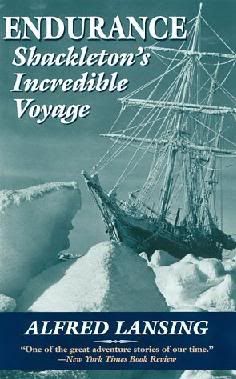
“[T]he stern of the Endurance rose 20 feet into the air and hung there for a moment with her motionless propeller and her smashed rudder held aloft. Then slowly, silently, she disappeared beneath the ice, leaving only a small gap of black, open water to mark where she had been. Within sixty seconds, even that was gone as the ice closed up again. It had all happened in ten minutes.
Shackleton that night noted simply in his diary that the Endurance was gone, and added: ‘I cannot write about it.’
And so they were alone. Now, in every direction, there was nothing to be seen but endless ice. Their position was 68 38 ½’ South, 52 28’ West – a place no man had ever been before, nor could they conceive that any man would ever want to be again.”
The story of the Imperial Trans-Antarctic Expedition is one of the great adventures tales of all time. Led by Ernest Shackleton, the expedition’s goal was to become the first party to cross Antarctica. But the men never even made it ashore. Before they hit land, their ship became trapped in the ice pack of the Weddell Sea. Eventually, the pressure ground the vessel to splintered smithereens, leaving the men stranded in the middle of one of the coldest, most desolate places on Earth. Certain death seemed imminent.
But that was not to be. It took over a year, but Shackleton succeeded in leading his team over the 850 miles of ice and water that separated them from civilization. Twenty-seven men were part of the expedition. Each and every one of them survived.
Many authors have told the story of Shackleton and his men. But Alfred Lansing’s account, published in 1959, has become the definitive classic. It’s inspiring, horrifying, and quite disgusting. The sheer amount of suffering these men endured on their journey is unimaginable. They were cold, wet, starved, and filthy for well over a year. One of them even developed a boil the size of a football on his arse.
Many parts of the book are nightmarish. Shackleton’s men were marooned on ice, not solid land. When summer arrived, the very foundation beneath their feet began to melt away. They had to wade through slush as they scrambled from floe to floe with their gear. If the ice broke up beneath them, they would’ve been plunged into what would almost certainly be an icy, icy death. Brr.
At one point, Lansing’s account even had me in tears. I won’t spoil it for any of you, except to say that while all of Shackleton’s men survived, Fido did not.
What impressed me most about the book, however, was the comradeship that developed among Shackleton’s men. With one or two exceptions, very few petty feuds and jealousies developed. Indeed, the men seemed almost obscenely chipper throughout much of the ordeal, and their attitude appears to have been the perfect epitome of British “keep a stiff upper lip” stoicism. In fact, it was so admirable that I often found myself wondering whether Lansing had whitewashed some of the more personally unpleasant aspects of the voyage in order to preserve its inspirational message.
Overall, however, anyone looking for an introduction to the story of the Endurance should pick up Lansing’s book. At the very least, go online and take a look at some of the expedition pictures. Shackleton took a photographer with him, and much of the journey was captured on film. They’re pretty amazing to see.
I’ll conclude with a newspaper advertisement that has been attributed to Shackleton:
Men Wanted: For hazardous journey. Small wages, bitter cold, long months of complete darkness, constant danger, safe return doubtful. Honour and recognition in case of success.
The above may very well be apocryphal. Regardless, it aptly fits the spirit of the Endurance legend.Labels: adventure, history, non-fiction, penguins as food, ships
posted by Elizabeth at
4:35 PM
6
comments
Monday, June 04, 2007
...but then I got high
Into Thin Air
Jon Krakauer
In the spring of 1996, Mt. Everest claimed twelve lives. Jon Krakauer was there at the beginning, when the mountain known as Sagarmatha to the locals took the first victims of the year, including two experienced guides, both of whom had summitted before.
Krakauer happened to be on that trip to document a more standard ascent of Everest for Outside magazine. Thus is made an important point: there is no such thing as a standard ascent of Everest.
Into Thin Air examines Everest from all angles long before documenting the events of May 1996, starting from the discovery (by very careful trigonometry--go, math!) that it was the world's highest peak and the near-immediate decision by a long line of adventurers to try to reach what became known as The Third Pole. Many turned back. A few died in the attempt, including some very accomplished and well-known alpinists.
There has been a lot of debate in recent years about whether the peak has become too commercialized, reduced to an instrument of commerce for the countries of Nepal and China, and the guide companies who escort their clients to the top. Are too many people visiting Everest? Will the trash they leave behind forever sully this dominating landscape? Have guide companies made it too easy, too accessible, and too commonplace to reach the summit? These are questions of not just fact and consequence, but ethics and spirit. If it becomes too easy to climb the most imposing mountain on our planet, then how will true mountaineers distinguish themselves from the rich tourists? And if the mountainside becomes littered with discarded oxygen bottles, will anyone still want to visit?
None of these stones are left unturned; Krakauer has doen extensive research and interviews to provide background, history, and haunting medical information about the effects of high-altitude climbing on people in general, and his party in particular. Most of the people who have recommended the book to me or saw me reading it somewhere have remarked that it would change my mind about ever wanting to climb Everest. In a way, they were right, but not for the reasons they thought: I was never that interested in climbing Everest. Part of me did for the same reason as Hillary--I hadn't done it, and it seemed like a unique venture, so why not? But the rest of me was disappointed that it had become so commercialized. It seemed that any reasonably fit person with the time and money to devote to the trip could do it, and in fact at least one of the expert guides detailed in the book makes the same claim. The people who told me to read the book expected that it would convince me not to climb. It should have. The experiences of the parties on the mountain from May 10-11 of 1996 were harrowing. Hell, just reading the book is enough to make you want to hide somewhere at tropical sea level with a blanket and a hot mug of something tasty.
Instead, it made me want to rise to that challenge. Perhaps it's my stubborn, determined nature, or my inherent deisre to do all the things I haven't yet done and see all the places I haven't yet been. Maybe it's some underlying self-destructive tendencies, because the strongest impression the book gave me was that even on a good day, even in the best of conditions, you don't climb Everest so much as pick a month or two to allow the mountain to slowly try to kill you. It robs you of sleep, oxygen, energy, heat, brainpower, and will. You hunger but can't keep anything down. You tire but can't sleep. You thirst, but have to melt snow before you can drink anything, and the entire time winds try to force you off the arete, snow and ice block your passage and assail you from the heavens, clouds obscure your vision, and when the sun does make it through, the reflection off of all the towers of ice threaten to cook your brains out of your head. The thinner atmosphere allows solar radiation to pummel and blind you even as it slows your progress with slow suffocation. Low oxygen levels mean more than gasping for air; it means you're more vulnerable to all of the mountain's previously mentioned threats, and your hypoxia-addled mind has even more trouble than usual handling those dangers. Ironically, the book made me want to climb Everst, just to see how far I can push myself. When you get right down to it, it's the only reason anyone climbs it. For that matter, it's the main reason I do almost anything.
Equally interesting to me was the epilogue and extended afterword (I read the 1999 printing) which detailed the aftermath not only in the lives of the survivors and the victims' families, but in Krakauer's extended literary debate with Anatoli Boukreev (one of the guides) and G. Weston DeWalt (an author who wrote Boukreev's story of the same incident), which raises questions of responsibility, fault (yes, those two are different), and journalistic ethics. Boukreev and DeWalt argue that Boukreev is without blame in the deaths on Everest, and disagree with Krakauer on some key points. Krakauer, though he mentions where Boukreev may have gone wrong, is also quick to point out throughout the book that Boukreev also played the role of hero, playing a vital role in rescuing at least two climbers. Krakauer is also needlessly hard on himself. He makes it absolutley clear, repeatedly, that he feels the deaths of two climbers (and emotional trouble for the loved ones of one of those climbers) is directly due to his own inactions. But for all the great deeds he performed during the climb, which played key roles in saving many other climbers, he only mentions them as a matter of course, as part of a complete recording of facts. DeWalt mentions only Boukreev's heroism, and then proceeds to defame Krakauer's character at every opportunity, even after Boukreev and Krakauer reconcile.
Jon Krakuer knows that the events of that climb will always haunt him, coated in the guilt he carries. After reading his story, it is only too clear why, though I feel he's too hard on himself. Such is the burden of survivors. Jon, I hope you can find some kind of peace. And maybe some day I'll have the opportunity to meet you and tell you in person that you saved more lives than you lost.Labels: adventure, evolutionary biology, health, high society, non-fiction
posted by reyn at
6:17 AM
3
comments
|
|