|
Monday, May 21, 2012
one-way ticket
Title: A Ticket to the Boneyard
Author: Lawrence Block
I like Bernie Rhodenbarr in short stories; it gives him the space to be witty without the onus of filling the vast volume between covers. Keller, in my limited experience, does a better job of filling those considerably larger shoes, if only because of his tendency to wax philosophic, rely upon Dot, and take his sweet time to do what he needs to do. To be fair, I've only read one Keller novel, but I've also only read one Matthew Scudder novel, and of Block's various protagonists, Matt is the reigning king. He regales with short stories, and easily holds his own through this brutal novel.
Years ago (book time), Matt put away a monster. An exceedingly cruel man with strong hands, knowledge of all the body's pain centers, and a disturbing skill at inflicting psychological damage. Now, long off the force, devoid of a PI license, and working for an agency, he finds out that James Leo Motley is free, and he's coming for Scudder. But first, he vows to kill "all your women." Matt is divorced; he has no family; he has no "women." Motley kills any woman connected to Scudder, starting with a woman who testified at his trial.
Hamstrung by lack of hard evidence and the police department's disbelief that it's happening, Matt is on his own to stop a vicious killer. In true hard-boiled form, he gets his ass kicked at least once.
Block's version of New York is all seedy underbelly. Scudder navigates it well, and has contacts with contacts. The real question is whether he's good enough to get Motley and put him away for as long as he deserves. The writing is as brutal as the antagonist, and the descriptions of what Motley does were enough to make me feel uncomfortable, but it's extremely well done. It makes me want to read the entire Scudder canon.
...On a nice, sunny day.Labels: murder, mystery/detective, noir
posted by reyn at
3:35 PM
0
comments

Friday, August 06, 2010
the beginning is the end
Title: The Thin Man
Author: Dashiell Hammett
The more I find of Hammett and Chandler, the more I like them. They bear little resemblance to today's mystery novels, but still built the foundation for them. The hard-nosed tough-guy investigator? The weird twists? Hammett and Chandler. Sadly, while newer books show great improvements in technology and investigative techniques, they've lost some of the qualities that made the older books so great, like Chandler's descriptions, and the matter-of-fact badassery of both authors. What's more, you can reasonably assume that Hammett's stuff is pretty accurate, because he was a Pinkerton man for many years (and served in two World Wars).
The Thin Man of the book's title is an inventor, and despite being the title character, we don't actually see him until the book is nearly over. Letters are received, notes passed, but he has no direct contact with the reader for several chapters. Meanwhile, his secretary is murdered, a suspect takes a shot at Nick Charles (among Hammett's most popular characters, Nick and Nora Charles debut in this book, which takes place several years after Nick has retired from sleuthing), his entire family turns out to be a bunch of loons, and his lawyer calmly manages his business affairs, contacting the Thin Man through newspaper ads while he goes on the lam as the police's number one suspect in the secretary's death.
Nick and Nora deserve their fame. Despite a July-November marriage, they have a great rapport. Nora is not quite a full partner in Nick's investigation, but she often has ideas that inspire him to make the necessary connections, and backs him up well by tending to several minor crises along the way. They seem to almost have the sort of telepathy developed only after decades of marriage. There is also an entertaining ease with which they handle the more bizarre events of the book. When a gunman appears in their hotel room, Nick carefully calculates, and cold-cocks his wife to the side to get her away from the line of fire before receiving a grazing wound and taking out the gunman. When she comes around, Nora is upset that Nick hit her so hard not because it hurt, but because she missed all the action. Later, when five men beat the hell out of someone coming to accost Nick in a bar, she drunkenly tells him, "I love you, Nicky, because you smell nice, and you know such interesting people."
Hammett is full of sly, dark humor that would make the book worth reading even if the story were dull--and it isn't--and the characters boring--and they aren't. The caper is only convoluted enough to work, stays believable, and tracks well. Long live the greats.Labels: mystery/detective, noir
posted by reyn at
1:00 PM
0
comments
Tuesday, July 06, 2010
Pulp mills of Mars
Title: Born Under Mars
Author: John Brunner
It's been well over a month since I've read this, and kind of a lot has happened since then, so I'm going to glaze over most of it.
Imagine a noir-ish pulp detective novel on Mars, centered around a conspiracy to create and control a baby that could alter the course of human evolution.
It's surprisingly well done (considering the outlandish premise), if you're able to think of it more as noir detective than sci-fi, and you're willing to ignore Brunner getting relativity backwards. Ray is a flight engineer, born on Mars (and due to a mere four or five generations of human life on Mars, has "evolved" to be very tall, lightweight, and physically weak, especially on higher-gravity worlds), and starts the book being tortured by operatives of one of the two primary factions of humankind. He is later revived by members of the opposite faction, and spends the rest of the book trying to figure out what everyone thinks he knows, and why his Yoda-like mentor erased twelve hours of his memory. Weird stuff, but perfect for a flight or a brain-dead evening.Labels: mystery/detective, noir, pulp, sci-fi, special abilities
posted by reyn at
5:08 PM
0
comments
Thursday, February 05, 2009
no, not that one
Title: Proven Guilty Author: Jim Butcher Bookmark: flattened candy box from Halloween leftovers
This is a story of a wizard names Harry who spends an inordinate amount of time fighting dark magic while struggling to maintain his life in the real world. Not that Harry. This Harry is named Dresden, and was named by his father after Harry Houdini (one of my childhood heroes). I know, it still sounds like a bit of a rip off, but that doesn't mean it's not really cool.
The Dresden Files, in addition to being a short-lived TV series, is a growing list of books that started as a protest against a writing assignment. This is number eight, because it was the only one on the shelf when I decided I wanted to read them. It's obvious that there are threads running throughout the series (one of the big plotlines in this book isn't even completely resolved), but Butcher does an elegant, subtle job of letting you know what you need to know without being heavy-handed and obvious.
Harry Dresden seems to be the undiscovered love child of Hermione Granger and Philip Marlowe, spouting off defensive spells and one-liners with equal ease. In this episode, he confronts an unspecified threat bringing phobophages (demons that feed on fear, and in this case, take the form of movie monsters) into our world from the Nevernever, deals with an ongoing war between the White Council of Wizards and the Red Court of vampires, starts a civil war in the Nevernever between Summer and Winter faeries, sees his brother (a sort-of vampire) move out of his apartment, struggles to protect the family of his friend (a holy warrior who carries one of three sacred swords, each of which contains a nail of the Cross, and seems to take his orders from God, or someone close), and wrangles politically with the most powerful wizard alive. Oh, and he does it all aided by a dog that may not be mortal while battling internally with a fallen angel who took up residence in his brain when he touched a cursed Roman coin in an earlier book.
There are a couple very minor concerns with continuity, and things get especially weird in the last third of the book, which takes place largely in the Nevernever, but it's still good fun. I might have to hunt down some of the earlier books to figure out what the hell's going on.
Labels: demonic possession, fairies, mystery/detective, noir, vampires, wizards
posted by reyn at
11:25 PM
1
comments
Saturday, December 01, 2007
Special Indeed
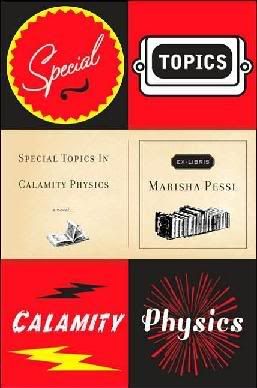
Title: Special Topics in Calamity Physics
Author: Marisha Pessl
Dad always said a person must have a magnificent reason for writing out his or her Life Story and expecting anyone to read it.
“Unless your name is something along the lines of Mozart, Matisse, Churchill, Che Guevara or Bond – James Bond – you best spend your free time finger painting or playing shuffleboard, for no one, with the exception of your flabby-armed mother with stiff hair and a mashed-potato way of looking at you, will want to hear the particulars of your pitiable existence, which doubtlessly will end as it began – with a wheeze.”
Given such rigid parameters, I always assumed I wouldn’t have my Magnificent Reason until I was at least seventy, with liver spots, rheumatism, wit as quick as a carving knife, a squat stucco house in Avignon (where I could be found eating 365 different cheeses), a lover twenty years my junior who worked in the fields (I don’t know what kind of fields – any kind that were gold and frothy) and, with any luck, a small triumph of science or philosophy to my name. And yet the decision – no, the grave necessity – to take pen to paper and write about my childhood – most critically, the year it unstitched like a snagged sweater – came much sooner than I ever imagined.
The above paragraphs open Marisha Pessl’s wonderful novel, Special Topics in Calamity Physics. (And it has a fantastic website, too. Follow the link!) Reading them in the bookstore, I felt the “book bug” sleeping inside me stir and flutter feebly. My “book bug” is a finicky creature. He emerges only when I’m head-over-heels in love with a story, completely infatuated. Despite my reading addiction, this happens but rarely – maybe once or twice a year. So when my “book bug” begins to uncurl, I pay attention. I eagerly swiped my credit card for Special Topics and prayed that the story didn’t disappoint. After all, so many books have great pick up lines, but wilt pathetically halfway through the night. And nothing annoys my book bug more than being stood up by a date.
But hurrah, Pessl lived up to – indeed, exceeded – expectations! Special Topics is so much more than a one night stand. Funny, dark, and unabashedly literate, it might even be my new favorite book.
Special Topics is narrated by Blue van Meer, whose nomadic life has revolved around books and her obscenely intelligent father. For years, Gareth van Meer has flitted from college to college on a string of visiting professorships, dragging his daughter with him. As a result, the extraordinarily bright Blue is a perennial outsider, with more knowledge of history than people. She’s the type of girl who thinks the number pi is sexy, musing, “I think it would be sort of electrifying if some kid heatedly whispered it into my ear. 3.14159265…”
But everything changes when Dad enrolls Blue at the prestigious St. Gallway academy. The halls of St. Gallway are ruled by the Bluebloods, an exclusive clique that has gathered in fascination around the school’s enigmatic film teacher, Hannah Schneider (see, The Prime of Jean Brodie). For reasons unbeknownst, Hannah takes a liking to the motherless Blue and forces the Bluebloods to accept her as one of their own. The Bluebloods aren’t happy about it, but comply, giving Blue new clothes, new hair, and an entirely new appreciation of the different varieties of fine liquor.
But the fun turns sour when Blue finds Hannah dead, her bloated body hanging from a tree during a camping trip in the Blue Ridge Mountains. Was it murder? Suicide? Blue sets out to discover the “who, what, when, where, why.” And along the way, she inadvertently rips her life to shreds.
The plot is a noirish whodunit-bildungsroman. The characters are vivid and appealing – particularly Blue’s Dad, who’s the most amusingly arrogant asshole academic you can ever hope to meet. But Pessl’s gorgeous writing is what truly sets Special Topics apart – her gorgeous, gorgeous, oh-my-god-it’s-better-than-chocolate writing. Her use of words is acrobatic, virtuoso, and just so damn fun. Everything whirls and glitters, and I found myself laughing on nearly every page…when I wasn’t shuddering.
Special Topics has a uniquely witty, yet academic, tone. Blue lays out her history as if it were a class syllabus, naming each chapter after a great work in the literary canon that thematically connects with the chapter’s plot. (For example, the chapter where Hannah dies is called “Deliverance, by James Dickey.”) Literary and cultural allusions abound, and Blue continuously references sources – both of the academic and popular variety – as she relives her involvement with the Bluebloods and Hannah’s death. Some of these sources are a product of Pessl’s imagination, but since they’re universally humorous and clever, this only adds to the fun.
I’ll admit that Special Topics might not be to all tastes. Some might find Pessl’s writing annoying, or the plethora of references pretentious. But I adored Special Topics precisely for its flamboyant wordiness. The book is an escapist fantasy for the literary-minded, full of sparkling intellectual chatter. It’s smart, but never dour; erudite, but not preachy. I look forward to reading it again – and again – and again.Labels: bildungsroman, fiction, humor, mystery/detective, noir
posted by Elizabeth at
12:35 PM
0
comments
|
|