|
Thursday, September 19, 2013
big damn recap
I'm not going to individually post for everything I've read since February. At this point, I'm pretty sure this page only exists as a personal log of what I've read (it's existed longer than Goodreads, and nobody tracks me here). A gift of a nook for Christmas let me go through lots of books I downloaded from the library, and our new building has a little library in the basement. Between those, and a couple real books, I've read:
All of Michael Connelly's novels published up to today. Echo Park was my favorite. Good characterization and dialogue. The novels which do not fit into one of his series tend to be a bit weaker than the rest, but Harry Bosch is still the king of the Connelly version of LA. Mickey Haller makes a good read, though his slippery ethics make me a little uncomfortable sometimes, but even he can't hold a candle to his half-brother the cop. They have a combined story coming out this fall, The Gods of Guilt, and I look forward to it, but more for the detective than the somewhat shady defense attorney. Haller's a fun character, but there's a pattern to all of his stories, while Bosch continues to get into new situations, with unique twists and clever plots.
The first two books in Sue Grafton's Alphabet series. A little dated, but fun. Made me wish more of her books were on the shelf downstairs.
I've caught up with Alan Bradley's Flavia De Luce series (the most recent to date being Speaking From Among The Bones). Still entertaining, and he finally got to the twist I predicted in the first book, but I will have to wait until the next book (The Dead in Their Vaulted Arches), due out next year, for any resolution.
Craig Johnson continues to amaze me with Walt Longmire. I've read up to the short story Divorce Horse, wedged into the series between Hell Is Empty and As The Crow Flies, and, as always, Johnson inspires and intimidates me. As I read his books, I want to be able to write that well, and am constantly dogged by the feeling that I can't. However, Divorce Horse was a little disappointing. I'm glad I didn't spend any money on it. Too much guessing is left in the resolution (even calling it a "resolution" feels like a sham), and it feels too much like what it is: table scraps thrown out to keep ravening fans busy until the book release. I'm still two books (and a few short stories) behind in the series, but Steamboat Springs is due out next month. If I play my cards right, I think I'll be ready for it when it gets here.
Lamb, by Christopher Moore, is just as clever, funny, ribald, and entertaining as everything else I've read by him. I liked the new take on Jesus's youth (not being a religious person, I could tell there were several references I didn't get, but I was still pleased with the story and the references I did get), but I think the part that was most personally significant for me was the Author's Bio at the end, which assured me that Moore was a "late-blooming child prodigy" who published his first novel in his mid-thirties. That's about where I am, so I feel a little better about my late start in writing. Hopefully, I can get my book out to agents soon, and maybe I'll be a late-blooming child prodigy, too.
I think that's everything that matters. I've also been re-reading The Hitchhiker's Guide to the Galaxy series on my nook, because sometimes I feel like reading, but I don't have a fresh book handy, and I've read that entire series so many times that I can dip in and out of it with aplomb, and not even care if I finish a chapter (though I usually do).Labels: decomposing bodies, demonic possession, ethics, girl power, mystery/detective, poison, western, young protagonists
posted by reyn at
9:35 AM
3
comments

Sunday, November 04, 2007
My Sister's Kidney
Title: My Sister’s Keeper
Author: Jodi Picoult
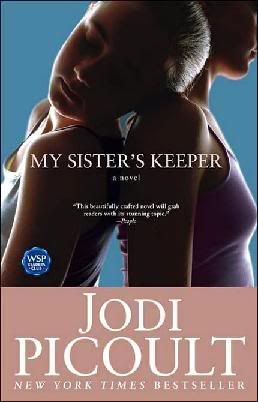
I can be a forgiving reader. Really. I enjoy the cheesiness of laughably bad books. The only books that I find truly detestable are those which insult my intelligence by discussing serious topics in a completely ridiculous manner. Unfortunately, Jodi Picoult’s My Sister’s Keeper is just one of these loathsome beasts.
Warning: I’m about to spoil the plot of this book shamelessly and with relish! If you had actually wanted to read it…tough.
Kate was diagnosed with leukemia when she was a baby. No one in her family was a perfect match as a donor, so her parents conceived another child for the sole purpose of being a “perfect match” for Kate. They ensured that the child could be a donor through “preimplantation genetic diagnoses.” Enter Anna. By the time Anna’s thirteen, she’s given blood transfusions, bone marrow, and stem cells in order to keep the sinking Kate afloat. Now Kate’s kidneys are failing, and she needs a transplant. Otherwise, she dies.
And guess what? Anna says “no.” No, Kate. No kidney for you.
We actually have a very interesting premise here. Anna hires a lawyer, Campbell, who specializes in obtaining “medical emancipation” for minors. If a court finds that her parents aren’t making medical decisions in her best interest, a judge will give the responsibility to Anna or a legal guardian. Is it in Anna’s best interest to donate her kidney to Kate? Can she be forced to do so? Does she have a legal obligation, a moral obligation? All fascinating questions, which could make for a ripping tell of medical and legal ethics.
But Picoult RUINS IT ALL.
First, she makes Campbell a secret epileptic. And Anna’s interim legal guardian, Julia, is Campbell’s ex-lover. They were high school sweethearts before Campbell inexplicably ditched Julia the day of graduation – which he only did because he’d just learned of his epilepsy and wanted to “protect” her from the truth. Still, sexual tensions simmer between them. However, every time they get close to tearing each other’s clothes off, Campbell feels an epileptic attack approaching and flees the room. Seriously. Every time. He’s just as compulsive about it as Clark Kent. Guess flashing lights aren’t the only stressors that cause seizures…
A not-so-seismic courtroom scene is the book’s climax, and Picoult springs several stupid “twists” upon the reader. I say “twists,” but that’s not really fair, because they’ve been obvious all along. See, Anna’s not really a selfish creature who is so possessive of her bodily organs that she’ll let her sister die instead of relinquishing one measly little kidney. Oh no. Anna refused only because Kate secretly asked her to. *everyone gasp* Apparently, a life in hospitals connected to tubes no longer appeals to Kate. Who knows, maybe she saw The Matrix and freaked. Either way, she’s ready to chuck it all. Anna agreed with the plan only reluctantly, after Kate threatened a gruesome suicide.
Oh, and immediately after Anna’s dramatic confession on the witness stand…Campbell suffers a seizure in front of everyone! Surprise!!! Now Julia knows the truth, and they can live happily every after. But really, why do we care?
(Oh, and there’s another lame side plot where Anna’s father, Brian, is a firefighter trying to discover the identity of an arsonist who has been striking with increasing frequency. In an ironic twist, the arsonist is his own son, who is clearly striking out because he feels he doesn’t get enough attention. Nice. But the son kind of has a point, I guess. I mean, I wouldn’t have cared about him except for the arson, and even with that, he only merited one measly paragraph in this review. Unfortunate boy.)
So now Anna’s an angel (the silly girl won’t even lie under oath), and Campbell and Julia are gazing at each other with bedroom eyes. But what about Kate? She can’t really let herself…die, can she? Isn’t that a wee bit…evil? Don’t suicides go to hell?
Don’t worry, little children, Mommy Picoult will make everyone happy again – or at least morally righteous! And they’ll all get into heaven.
Oh, but Mommy Picoult, how?
Simple. As Campbell, Julia, and Anna drive from the courtroom in the rain – a giant truck hits their car! Campbell and Julia are badly injured, but live. Anna dies. How sad. Actually, she’s brain dead, although still breathing on a respirator. Campbell and her parents decide to pull the plug. Her kidney is quickly harvested and transplanted into Kate, who’s wavered in her determination not to receive it now that her sister’s pavement pancake. Kate makes a miraculous recovery and lives on indefinitely. Yay.
Despicable.
Picoult raised all those interesting questions – medical emancipation, a patient’s right to refuse treatment, etc. – and copped out on them all. None of them resulted in real consequences. How cowardly. Grow a backbone, Jodi. Better yet, if you have siblings, rip one out from them. I’m sure they don’t need it as much as you.
Actually, there was one good thing about this book: Campbell has a dog with him at all times that is trained to detect impending seizures. Whenever someone asks what the dog is for, Campbell gives a smart-ass answer. For example: “I have an iron lung, and he keeps me away from magnets.” “I’m a recovering alcoholic, and he keeps me out of bars.” Or, “I’m color-blind, he tells me when traffic lights change.” Ha! Those were great.
Several months ago, I met a colleague who was clearly very intelligent and driven and dedicated to her career. At first, I found her rather intimidating. But when we were discussing books several weeks ago, she mentioned a pure adoration of Jodi Picoult. While doing so, her eyes shone with genuine admiration.
I’m not intimidated by her anymore.Labels: epilepsy, ethics, fiction, leukemia, melodrama
posted by Elizabeth at
8:38 AM
5
comments
|
|