|
Wednesday, July 29, 2009
Fat Bastard
Title: Star Wars: Tales From Jabba's Palace
Edited by: Kevin J. Anderson
Bookmark: boarding pass stub
It's a collection of short stories about what goes on behind the scenes in Jabba's Palace. Most of them overlap with the day Luke kills the Rancor and gets taken to the Sarlacc. Most of them are at least a nice diversion, with one glaring exception (someone tried to go all Lovecraftian with a snot vampire, and it's just painful to read), but the truth is, this is either aimed at a much younger audience, or a much lower reading level. I enjoyed most of it, but at the time, I was spending a lot of time in planes and airports, so I only needed a little diversion to keep me occupied.
PS, it turns out there were at least a dozen plots to kill Jabba at the time.Labels: evil empire, sci-fi
posted by reyn at
11:32 AM
0
comments

Tuesday, May 20, 2008
Trifecta of Imperial Doom
Title: American Theocracy: The Peril and Politics of Radical Religion, Oil, and Borrowed Money in the 21st Century
Author: Kevin Phillips
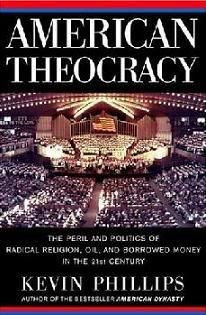
American Theocracy: The Peril and Politics of Radical Religion, Oil, and Borrowed Money in the 21st Century, penned by lapsed Republican Kevin Phillips, is an interesting and informative read. Nevertheless, the thesis of the book can be summed up in a simple syllogism.
Major Premise: All empires crumble.
Minor Premise: The United States of America has become an empire.
Conclusion: We’re going down, friends.
Phillips’ book excoriates the Republican coalition that has dominated American politics for the past several decades, unified by an unhealthy reliance on oil, radical religion, and ballooning levels of national and consumer debt. If these three trends continue unchecked, Phillips argues, we’re heading for a massive meltdown. I read American Theocracy months and months ago, long before the home mortgage crisis, $125/barrel oil, and the advent of Mike Huckabee. Given the events of the past few months, Phillips just might have a point. It’s a little (ok, very) frightening.
This book is chock full of facts piled upon facts piled upon more facts. My sieve-like memory has retained very few of them, except for the general outline of how imperial Britain, the Netherlands, and Spain exhibited symptoms similar to the United States’ current woes before fading into (relative) imperial obscurity. And the chapters that outlined the history of the oil industry in the United States were surprisingly gripping, full of political shenanigans and examples of our cultural and social reliance upon black gold. In fact, Phillips was so effective in illustrating the United States’ reliance upon oil, and the dire consequences that may hold for our future, that even I began to have an imperial hunger for places like Iraq. If the President was determined to invade Iraq and wreak havoc, the least we could have done was secure cheap oil to feed our addiction! (Don't worry, I snapped out of it soon.)
Phillips’ arguments are appealing and appear to make sense, but I don’t consider myself sufficiently informed to judge whether he’s correct or not. That’s a job for history and better economists than I. Still, my view of the upcoming decades is hardly rosy. The United States might not slip into Phillips’ predicted headlong decline, but we may as well be prepared for the possibility.
A recent editorial by Phillips reminded me that this review was long overdue. I don’t really expect my fellow Ragers to read this behemoth of small type and doomsday commentary, but the article is brief and gives you the general idea.Labels: commentary, evil empire, non-fiction, politics
posted by Elizabeth at
7:30 PM
2
comments
Thursday, January 17, 2008
in the days long before James Bond...
Title: Washington's Spies: The Story of America's First Spy Ring
Author: Alexander Rose
Apparently this was a December of random book choices (yes, it's January now, but I read it then).
The book presents a very detailed history of the spying done by the American side during the Revolutionary war, including information about the men's (there was a possibility of involvement of one woman, but otherwise all men) lives, excerpts from their letters, and some examples of codes used, as well as stories of near-misses and actual captures (usually resulting in death). If you're into the Revolutionary War, this would probably be fascinating. I don't remember why I got this out from the library, since that's not exactly one of my interests. A few things struck me while reading. First, it reinforced the amazing advances in technology that have taken place in a very short (relatively speaking) time. It was considered good for a letter to leave a spy's hands and travel by courier(s) to a commanding officer in the space of about a week. A week! More importantly, I have forgotten anything I may have learned in AP US History (that was the class, right?). I had a hell of a time keeping track of who was on which side, because there were so many labels involved - Tories, Redcoats, Loyalists, Whigs, and several others that I now forget. And anytime there was talk of someone being at a fort, or going to a fort, or spying on a fort, that was even worse, because all the forts on both sides are named "Fort [British name]". There's no good excuse for confusing Tories and Whigs, but I seriously needed a chart of the lesser-known officers and their forts. There was a very happy moment for me after getting about 2/3 through the book - it abruptly ended and we hit the footnotes section!
Not really recommended for the casual reader. Find a trashy novel instead.Labels: evil empire, history, hunky armed forces or government operatives, Revolutionary War, war
posted by ket at
3:38 PM
0
comments
Monday, April 23, 2007
somewhat out of character
Title: Act of War
Author: Dale Brown
Stolen nuclear weapons are used to take out a Haliburton-like complex (and a radius of several miles surrounding it). The country goes on the defensive, and Jason’s top-secret project gets called into action while still in development – robot-like contraptions that a person rides in and controls, so they’re essentially super-human.
There’s lots of intrigue and conspiracy and a group of environmentalists that are blamed for the nukes because they have an infiltrator who wants revenge for someone taking over something in Russia, and the President’s almost killed a few times, and he’s got a traitor near the top, etc., but Jason and his team save the day in the end.
Half the reason I made myself finish this book is because it’s NOT a trashy novel. But I like those. This was okay, but a bit too serious for what I’m going for when reading fiction…Labels: evil empire, hunky armed forces or government operatives
posted by ket at
11:42 PM
1
comments
Friday, October 13, 2006
What a Kroc!!
Fast Food Nation
Eric Schlosser
I love when restaurants, or to use a more appropriate term, eateries, name themselves after their menu. Places like Cold Beer and Cheeseburgers, or BW3 back before they, like my alma mater, caved and just started calling the place what everyone else called it, and it was still Buffalo Wild Wings. It's great because you never have to wonder what they have, or what their signature menu item is. I was certain that I had heard the person wrong the first time I heard Fuddruckers, and it was months later before I found out they had burgers. (Years after that, I actually went to one and discovered they were also extremely pricey burgers) However, no matter how entertaining it may be, it's not always a good idea. Two days ago I noticed a Fatburger on my way back from work. It did not entice me to place an order.
Neither will this book.
I was actually encouraged to read it with the warning, "You'll never eat fast food again," but because I usually don't eat it anyway (Chipotle totally doesn't count), I didn't consider this much of a threat.
They were wrong. It made me seriously reconsider eating at all.
Schlosser starts by describing the history and rise of fast food as an industry. He describes how the businesses operate at both a corporate and franchise level, and the interaction between the two. Intimate details of the meatpacking industry are revealed in what may be my favorite chapter, What's in the meat (Direct quote: "There is shit in the meat." That's not Schlosser. That's one of his interviews.), and the secrets behind artificial and "natural" flavors are unearthed. In true liberal avenger form, he even shows us the deplorable working conditions for the fast food and meatpacking workers. This is where I point out that although I agree that the workers need better conditions, I in no way support his view that everybody should union up, but that's just my view.
McDonalds is an obvious target throughout, if only because they still abide by Ray Kroc's corporate philosophy. This is a man who once said of his business rivals, "If they were drowning to death, I would put a hose in their mouth." Schlosser attacks from all sides, and I can't say I blame him. I stopped eating there when I discovered that not only was the toy the best part, but it usually wasn't any good.
I had two other favorite quotes I'd like to share, and I won't even mention the CWRU professor who's cited in the afterword. First, from What's in the meat:
"A series of tests conducted by Charles Gerba, a microbiologist at the University of Arizona, discovered far more fecal bacteria in the average American kitchen sink than on the average American toilet seat. According to Gerba, 'You'd be better off eating a carrot stick that fell in your toilet than one that fell in your sink.'"
I have a small issue with this, because if you're getting fecal matter on the seat, then you were clearly not properly instructed in how to operate a toilet. But it still says a lot about how dirty the meat is when it gets to your home.
Finally, the line I almost used to open this post:
"Plauen has become a battlefield for these competing ideologies, with their proudly displayed and archetypal symbols: the swastika, the hammer and sickle, the golden arches."
That line summarizes the entire book, from the global reach of the industry--making us not a fast food nation, but a fast food planet--to Schlosser's obvious view that McDonald's is just another evil empire.
I agree with this assertion, but I have for a long time. That's the problem. The only people who are going to read this book unless it is forced upon them are the ones who don't need convincing.Labels: evil empire, food, health, shit
posted by reyn at
6:46 AM
3
comments
|
|